


After receiving an admission letter from a Chinese university, many students and parents begin to ask an important question: “How far in advance should I apply for my visa before travelling to China?”
This is an important step in preparing to study in China. Applying too close to the enrolment date may leave students with limited time to complete their documents, address unexpected issues or arrange their flight.
In addition to the visa, international students should also prepare their passport, admission documents, personal documents and luggage, and carefully check Chinese customs requirements before travelling.
According to the current information provided by the Chinese Visa Application Service Centre in Hanoi, applicants are advised to submit their visa application approximately three months before their intended arrival in China. Applicants should also ensure that their passport is valid for at least six months and has at least two blank pages. (Chinese Visa Application Service Centre in Hanoi)
1. WHICH CHINESE VISA DO INTERNATIONAL STUDENTS NEED?
Depending on the duration of study, international students generally apply under one of two categories:
X1 Visa – Long-term study
The X1 visa is intended for students undertaking study in China for more than 180 days.
The basic requirements for an X1 visa generally include:
-
A valid passport;
-
A completed Chinese visa application form;
-
An Admission Letter issued by the Chinese educational institution;
-
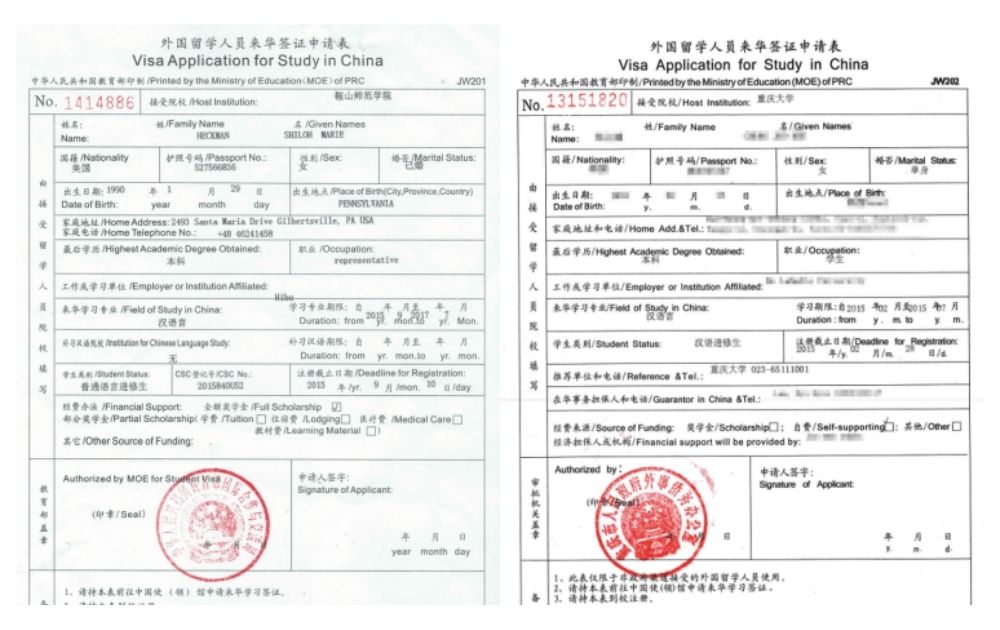
JW201 or JW202 – Visa Application for Study in China, where applicable.
The Chinese Visa Application Service Centre confirms that the X1 visa is intended for study programmes lasting more than 180 days and requires an Admission Letter together with the relevant JW201/JW202 documentation. (Chinese Visa Application Service Centre)
X2 Visa – Short-term study
The X2 visa is intended for study in China for no more than 180 days.
The basic documents generally include:
-
Passport;
-
Visa application form;
-
Admission Letter issued by the Chinese educational institution.
For X2 applications, JW201/JW202 is not included in the basic document list stated in the relevant visa guidance. (Chinese Visa Application Service Centre)
2. HOW FAR IN ADVANCE SHOULD YOU APPLY FOR A CHINESE STUDENT VISA?
Recommended: start preparing 2–3 months before enrolment
The Chinese Visa Application Service Centre in Hanoi currently recommends that applicants submit their visa application approximately three months before travelling to China.
This is a useful planning timeframe, particularly for international students whose visa applications depend on receiving all required documents from their educational institution. (Chinese Visa Application Service Centre in Hanoi)
This does not mean that a Chinese visa always takes three months to process.
The three-month period should be regarded as a recommended preparation timeframe, allowing students enough time to complete their documents and deal with any unexpected issues.
Visa processing may take less time
The actual processing time may depend on:
-
Visa category;
-
Completeness and accuracy of the application;
-
Whether additional documents are requested;
-
Whether an interview is required;
-
The decision of the relevant Chinese consular authority.
Importantly, the standard processing period does not guarantee that a visa will be issued within that timeframe. Consular authorities may request additional documents or an interview when necessary. (Chinese Visa Application Service Centre)
Students should therefore avoid booking flights too close to their enrolment date based solely on the standard visa processing time.
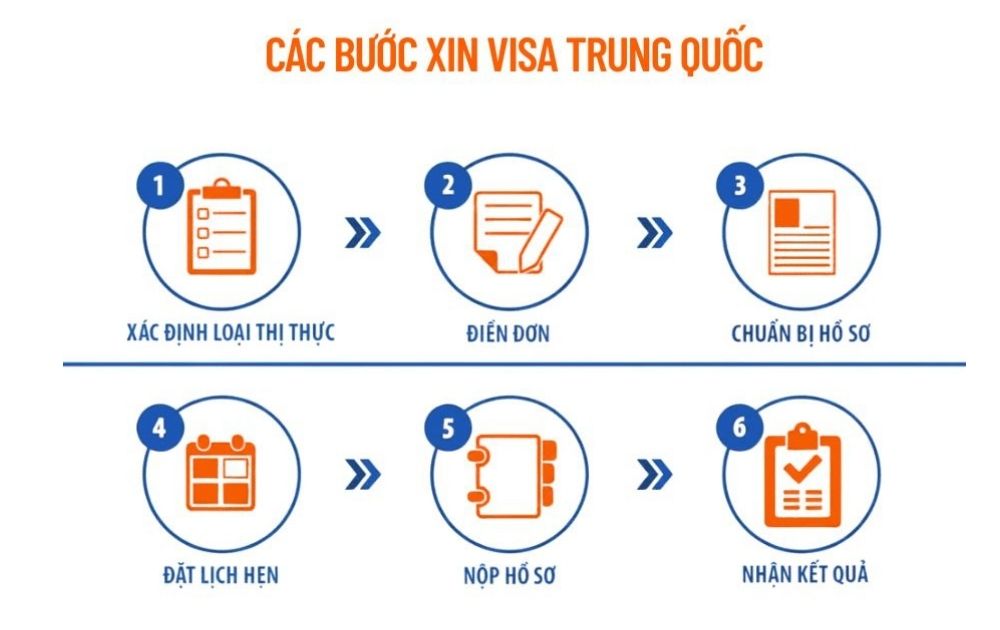
3. THE CURRENT CHINESE VISA APPLICATION PROCESS
An important procedural change that students should be aware of is that, since 30 June 2025, applicants submitting Chinese visa applications in Hanoi have been required to complete the visa application form online and upload their documents through the relevant system.
Before visiting the Visa Application Centre to submit their passport and documents, applicants should check that their application status has reached “online review completed” and bring the confirmation email and the required attachments as instructed. (Chinese Visa Application Service Centre in Hanoi)
The process can generally be understood as:
Receive admission documents → determine the appropriate visa category → complete the online application → upload documents → wait for online review completion → bring passport and documents to the Visa Application Centre → submit the application → collect the visa → prepare for departure.
4. DOCUMENTS TO PREPARE BEFORE APPLYING FOR THE VISA
Personal documents
Students should check:
-
Passport validity;
-
At least two blank passport pages;
-
Photograph meeting the applicable requirements;
-
Consistency between passport details and the visa application;
-
Other personal documents required for the individual application.
The Chinese Visa Application Service Centre in Hanoi currently advises applicants that passports with less than six months’ validity may result in visa refusal or difficulties when entering China and recommends renewing such passports. (Chinese Visa Application Service Centre in Hanoi)
Documents issued by the Chinese educational institution
For an X1 visa, students should pay particular attention to:
-
Admission Letter;
-
JW201 or JW202, where applicable;
-
Any additional documents requested by the educational institution or consular authorities.
For X2 applications, the basic documentation includes the Admission Letter and other documents required under the applicable visa procedures. (Chinese Visa Application Service Centre)
Do not omit documents without checking
Document requirements may vary depending on the individual case. Consular authorities may request additional documents or an interview if necessary. (Chinese Visa Application Service Centre)
Students should therefore check the current document requirements of the Chinese Visa Application Centre where they will submit their application, rather than relying solely on an old checklist shared on social media.
5. WHAT SHOULD YOU DO AFTER YOUR VISA IS APPROVED?
Receiving the visa is not the final step.
For students holding an X1 visa, after entering China they must continue with the procedure to obtain a residence permit for foreigners from the relevant local public security exit-entry administration authority.
According to the Chinese Visa Application Service Centre’s guidance, holders of an X1 visa must apply for a residence permit within 30 days of entering China. (Chinese Visa Application Service Centre)
Students should therefore remember:
X1 visa → enter China → complete the residence-permit procedure within the required period.
An X1 visa should not be treated as a substitute for a residence permit for the entire period of study.
6. WHAT SHOULD STUDENTS PREPARE BEFORE DEPARTURE?
Once the visa has been issued, students should move on to the departure-preparation stage.
1. Check all important documents
Students should prepare both originals and copies or electronic versions of important documents, including:
-
Passport;
-
Chinese visa;
-
Admission Letter;
-
JW201/JW202, where applicable for X1 applicants;
-
Documents relating to the educational institution;
-
Accommodation or dormitory information;
-
Flight ticket;
-
Contact details for the university;
-
Details of the person responsible for meeting the student at the airport, if applicable.
It is advisable to save scanned copies on a mobile phone and in secure online storage so they remain accessible if the originals are lost.
2. Check your flight arrangements
Students should avoid booking flights too close to the enrolment date.
In addition to travel time, allow sufficient time for:
-
Airport procedures;
-
Baggage collection;
-
Immigration procedures;
-
Travel from the airport to the university;
-
University registration;
-
Dormitory check-in.
If the university specifies an enrolment date or airport pick-up schedule, students should follow the university's arrangements.
3. Prepare money and payment methods
Students should carry a reasonable amount of cash for their first few days and prepare suitable payment methods for use in China.
Keep separate records of:
-
Bank account information;
-
Payment cards;
-
Emergency contact details in case a card is blocked or lost;
-
Emergency funds.
Do not keep all money and important documents together in one piece of luggage.
7. ENTERING CHINA: WHAT DOES CUSTOMS CHECK?
This is an area that many students overlook.
According to the General Administration of Customs of the People's Republic of China, passengers' baggage entering China should be for personal use and in reasonable quantities. Whether a quantity is considered reasonable is assessed based on the purpose of the journey and the length of stay. Goods carried for sale or lending are not regarded as ordinary personal baggage. (General Administration of Customs of the People's Republic of China)
Students should therefore avoid carrying large quantities of identical goods without a reasonable personal-use purpose.
8. ITEMS STUDENTS SHOULD NOT BRING INTO CHINA WITHOUT CHECKING THE RULES
Chinese Customs publishes lists of goods prohibited from entering China. These include, among other categories:
-
Weapons and imitation weapons;
-
Ammunition;
-
Explosives;
-
Counterfeit currency and securities;
-
Certain documents and materials prohibited under Chinese regulations;
-
Certain animals, plants and related products subject to prohibition or quarantine requirements.
Chinese Customs requires passengers to make declarations where applicable. Failure to declare, or attempts to evade customs supervision when carrying prohibited, restricted or dutiable goods or articles, may result in measures being taken in accordance with the relevant regulations. (General Administration of Customs of the People's Republic of China)
Before packing, students should therefore check the current list of prohibited and restricted items rather than relying solely on the experience of friends or previous travellers to China.
9. SPECIAL ATTENTION TO FOOD AND ANIMAL OR PLANT PRODUCTS
This is a category requiring particular caution.
Students should not bring animal, plant or animal- and plant-derived products into China without first checking the applicable quarantine requirements.
Certain products may be prohibited or subject to quarantine inspection and may be detained or disposed of at the border.
A simple rule is:
If you are unsure whether an item is permitted, check with Chinese Customs before travelling.
Do not assume that because a product can legally be sold in Vietnam, it can automatically be brought into China.
10. HOW SHOULD STUDENTS PACK THEIR LUGGAGE?
There is generally no need to bring too many belongings from Vietnam.
Priority should be given to:
Group 1 – Documents
-
Passport;
-
Visa;
-
Admission Letter;
-
University documents;
-
Necessary personal documents;
-
Copies of important documents.
Group 2 – Clothing
Choose clothing according to the weather in the destination city and the time of year when you will begin your studies.
There is no need to bring excessive amounts of clothing if additional items can be purchased in China.
Group 3 – Personal belongings
Bring only the items you are likely to need during the initial period.
Group 4 – Medicines and healthcare products
If you need to bring personal medication, check its ingredients, quantity and the relevant Chinese import requirements in advance.
Do not carry medicines with unclear ingredients or large quantities without appropriate documentation.
11. CHECKLIST: 7 DAYS BEFORE DEPARTURE
Documents
-
Check passport and visa
-
Check Admission Letter
-
Check JW201/JW202 if applying under X1
-
Save electronic copies of important documents
-
Save the university and dormitory address
-
Save the contact details of the university representative
Flight
-
Check flight date and time
-
Check checked baggage allowance
-
Check cabin baggage requirements
-
Confirm transport arrangements from the airport to the university
Luggage
-
Check all food products
-
Check medicines
-
Do not pack prohibited items
-
Do not carry excessive quantities of goods for non-personal purposes
-
Check animal, plant and related products
Finance
-
Prepare suitable payment methods
-
Prepare emergency funds
-
Save bank and card information
12. SUGGESTED TIMELINE FOR INTERNATIONAL STUDENTS
Students can use the following timeline as a general guide:
3 months before enrolment
→ Complete university admission documents and review visa requirements.
→ Prepare your passport and personal documents.
Approximately 2–3 months before enrolment
→ Confirm whether you should apply for an X1 or X2 visa.
→ Complete the online visa application and prepare the documents according to the current requirements.
→ Submit the application through the Chinese Visa Application Service Centre.
The Chinese Visa Application Service Centre in Hanoi currently recommends submitting a visa application approximately three months before travelling to China. (Chinese Visa Application Service Centre in Hanoi)
After receiving the visa
→ Check all information printed on the visa.
→ Confirm your flight.
→ Finalise accommodation and arrangements for arriving at the university.
→ Check luggage and customs requirements.
7 days before departure
→ Complete the document, luggage, financial and contact checklist.
On arrival in China
→ Keep your passport, visa and important documents in your cabin baggage.
→ Complete immigration and customs procedures as instructed.
After entering China with an X1 visa
→ Contact your university and complete the necessary registration procedures.
→ Apply for the residence permit within 30 days of entry into China, in accordance with the applicable requirements for X1 visa holders. (Chinese Visa Application Service Centre)
CONCLUSION
Studying in China involves more than receiving an Admission Letter and booking a flight. A well-organised preparation plan should follow a clear sequence:
Receive Admission Letter → prepare visa documents → apply for the visa at the appropriate time → check luggage → review customs requirements → prepare for departure → enter China → complete residence procedures.
For students undertaking long-term study, the X1 visa is intended for programmes lasting more than 180 days, while the X2 visa is intended for programmes lasting no more than 180 days. Visa requirements should always be checked according to the individual case. (Chinese Visa Application Service Centre)
In particular, the Chinese Visa Application Service Centre in Hanoi currently recommends that applicants prepare and submit their applications approximately three months before their intended arrival in China. This gives students sufficient time to address document issues and minimise the risk of having to change their travel arrangements at short notice. (Chinese Visa Application Service Centre in Hanoi)
Visa, immigration and customs regulations may be updated. Students should therefore re-check the latest official information from the Chinese Visa Application Service Centre, the Chinese Embassy/Consulate and the General Administration of Customs of China before submitting their application and again before departure.
OFFICIAL INFORMATION SOURCES
Chinese Visa Application Service Centre in Hanoi:
Chinese Visa Application Service Centre – Hanoi
General Administration of Customs of the People's Republic of China – International Passenger Customs Guide:
China Customs – Passenger Customs Guide
General Administration of Customs of the People's Republic of China:
China Customs Official Website
CONTACT INFORMATION
SONG DA TOHOKU JOINT STOCK COMPANY
Address: L02-L01, Area A, Duong Noi Urban Area, Duong Noi Ward, Hanoi, Vietnam
Hotline: 0989044852
Email: tohokusongda2014@gmail.com
Website: tohoku.vn