


The primary purpose of a student visa is education. Learning how to manage your time effectively is the key to achieving academic success while balancing part-time work. Understanding these principles before arriving in Japan will help you make the most of your study abroad experience.
Comply with the 28-Hour Weekly Part-Time Work Limit
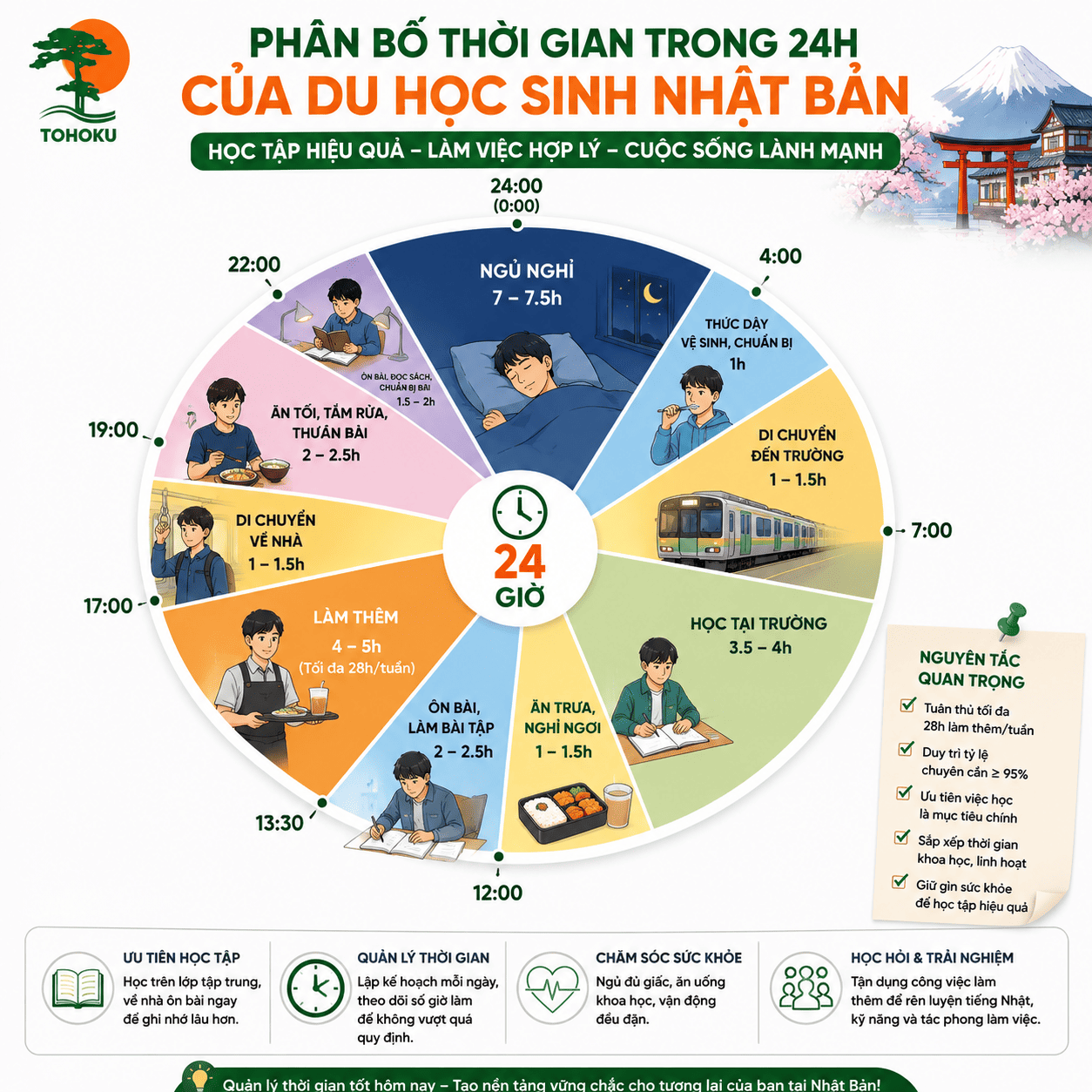
Under Japanese regulations, international students who have obtained a Permission to Engage in Activity Other Than That Permitted by the Status of Residence Previously Granted (資格外活動許可) are allowed to work up to 28 hours per week during academic terms.
During long school holidays, students may work longer hours in accordance with current regulations. However, exceeding the 28-hour weekly limit during the academic term can lead to serious consequences, including:
-
Violating the conditions of your residence status.
-
Difficulties when renewing your student visa.
-
Negative impacts on changing to a work visa after graduation.
-
Possible penalties imposed by the Immigration Services Agency of Japan.
Part-time work should support your education—it should never become the primary purpose of your stay in Japan.
Maintain a High Attendance Rate
Attendance is one of the most important factors monitored by Japanese language schools and the Immigration Services Agency of Japan.
In general, international students should aim to maintain an attendance rate of 95% or higher. Frequent absences or repeated lateness may affect:
-
Academic performance.
-
Your school's evaluation.
-
Student visa renewal.
-
Opportunities to progress to vocational colleges or universities.
-
Employment prospects in Japan after graduation.
Never sacrifice your education and future career for a few additional work shifts.
Create a Well-Balanced Study and Work Schedule
Rather than arranging your activities randomly, establish a consistent weekly routine.
Morning
-
Attend classes.
-
Take clear and organized notes.
Afternoon
-
Review lessons for 1–2 hours.
-
Complete assignments.
Evening
-
Work your scheduled part-time shift.
Weekends
-
Review what you have learned.
-
Prepare for the upcoming week.
-
Rest and recover.
A structured schedule helps you control your working hours while ensuring your studies remain your top priority.
Practical Tips for Balancing Study and Part-Time Work
1. Don't Take Too Many Shifts During Your First Few Months
When you first arrive in Japan, you need time to adapt to your new environment, including daily life, public transportation, school routines, and communicating in Japanese.
During your first one or two months, it is advisable to work only 12–20 hours per week. Once you have settled in, you can gradually increase your working hours while staying within the 28-hour weekly limit.
2. Choose a Job Close to Your School or Home
Working near your school or accommodation saves valuable commuting time.
The time you save can be used to:
-
Review your lessons.
-
Prepare meals.
-
Get adequate rest.
-
Sleep longer.
A job with slightly lower pay but a shorter commute may provide greater long-term benefits.
3. Avoid Late-Night Shifts Whenever Possible
If you have classes the following morning, try to choose shifts that finish before 10:00 p.m.
Regularly staying up late can lead to:
-
Fatigue.
-
Poor concentration in class.
-
Arriving late for lessons.
-
Lower attendance rates.
4. Always Prioritise Your Studies
Whenever you receive your examination schedule or school event calendar, inform your manager as early as possible so your work schedule can be adjusted.
Many employers in Japan understand that international students are in Japan primarily to study and are willing to accommodate academic commitments when given sufficient notice.
5. Review Your Lessons on the Same Day
Spending just 30–60 minutes reviewing what you learned after each class can help you:
-
Remember vocabulary more effectively.
-
Understand lessons more thoroughly.
-
Reduce stress before examinations.
This is a common habit among high-performing international students.
6. Keep Track of Your Working Hours
Do not rely solely on your employer's schedule.
Record your own:
-
Daily working hours.
-
Weekly total hours.
-
Monthly total hours.
This helps ensure that you never accidentally exceed the legal working-hour limit.
7. Develop the Habit of Being Punctual
Punctuality is highly valued in Japanese workplaces.
Aim to arrive 10–15 minutes before your shift begins so that you have enough time to:
-
Change into your uniform.
-
Prepare for work.
-
Receive a handover from the previous shift.
This simple habit demonstrates professionalism and helps build trust with your supervisors and colleagues.
8. Communicate Whenever You Encounter Difficulties
If your class schedule changes or you are feeling unwell, notify your manager as early as possible.
Providing advance notice shows responsibility and allows your employer to adjust staffing arrangements accordingly.
9. Treat Your Part-Time Job as a Learning Opportunity
Part-time work offers much more than additional income. It also allows you to develop:
-
Japanese communication skills.
-
An understanding of Japanese workplace culture.
-
Customer service skills.
-
Teamwork abilities.
-
Professional work ethics.
These experiences will become valuable assets when applying for full-time employment after graduation.
Take Care of Your Health
Maintaining a demanding schedule is only possible if you stay healthy.
Make it a habit to:
-
Sleep 6.5–8 hours each night.
-
Eat a balanced and nutritious diet.
-
Stay properly hydrated.
-
Exercise regularly.
-
Allow yourself enough time to rest and recover.
Good health enables you to perform better both academically and professionally.
Conclusion
Time management is one of the most important skills for international students in Japan. By complying with the 28-hour weekly work limit, maintaining a high attendance rate, following a well-organised study schedule, and developing healthy daily habits, you can successfully balance your education and part-time employment.
Many successful international students in Japan share the same principle:
Let your studies determine your work schedule—not the other way around.
When education remains your highest priority, you not only improve your chances of a smooth visa renewal but also build a solid foundation for further study, future employment, and long-term career success in Japan.
FOR FURTHER INFORMATION, PLEASE CONTACT
Song Da TOHOKU Joint Stock Company
Address: L02-L01, Area A, Duong Noi Urban Area, Duong Noi Ward, Hanoi, Vietnam
Website: https://tohoku.vn
Hotline: +84 989 044 852
Email: tohokusongda2014@gmail.com