


In a Japanese Rirekisho (履歴書), the Self-PR (自己PR) section is one of the most important parts of your application. It gives you the opportunity to highlight your strengths and demonstrate why you are the right candidate for the position.
If you have not yet read our complete guide to writing a Japanese CV, we recommend starting with:
👉 10 STEPS TO WRITING A CV (RIREKISHO) FOR JAPANESE COMPANIES
This article will help you understand the overall structure of a Japanese CV before focusing on the Self-PR section.
Many Vietnamese applicants simply write statements such as:
-
I am hardworking.
-
I am eager to learn.
-
I have a strong sense of responsibility.
While these qualities are positive, they are not enough to make you stand out. Japanese employers want more than a list of strengths—they want evidence that supports your claims.
What Is Self-PR (自己PR)?
Self-PR is the section where you introduce your personal strengths by describing real experiences that demonstrate your abilities.
Its purpose is to answer three important questions:
-
What are your strengths?
-
How have you demonstrated them?
-
How will these strengths benefit the company?
This is not a place to repeat your educational background or employment history. Instead, it should emphasise the qualities that make you a suitable candidate for the position.
What Do Japanese Employers Look For?
Japanese employers often value candidates who demonstrate:
-
Responsibility
-
Teamwork
-
Discipline
-
Attention to detail
-
Willingness to learn
-
A Kaizen (continuous improvement) mindset
-
Problem-solving skills
-
Consistent and reliable work habits
Rather than simply listing these qualities, explain how you have demonstrated them in practice.
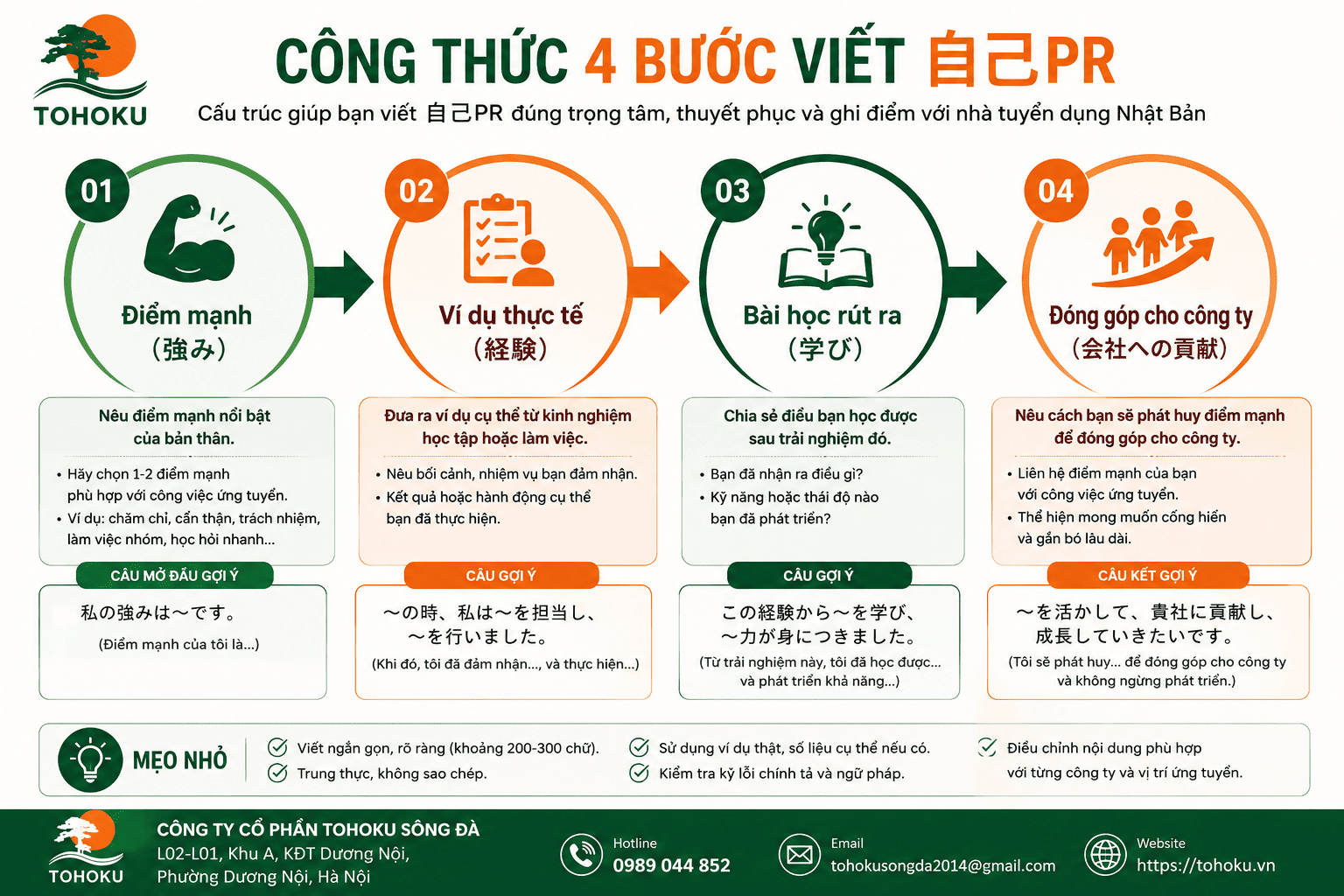
A Four-Step Formula for Writing an Effective Self-PR
Step 1. Introduce Your Main Strength
Choose one key strength that best represents you.
For example:
-
I work well in a team.
-
I pay close attention to detail.
-
I have a strong sense of responsibility.
-
I learn new skills quickly.
Focusing on one or two strengths makes your Self-PR clearer and more convincing.
Step 2. Support It with a Real Example
This is the most important part of your Self-PR.
For example:
While working in a mechanical workshop, I regularly collaborated with my colleagues to complete urgent production orders on schedule. Through effective teamwork, our production team consistently met deadlines and occasionally finished ahead of schedule.
Specific examples build credibility and help employers understand your abilities.
Step 3. Explain What You Learned
After describing your experience, explain what you gained from it.
For example:
This experience taught me that clear communication and mutual support are essential for achieving high-quality results and maintaining an efficient workplace.
This demonstrates your ability to reflect, learn, and develop professionally.
Step 4. Connect It to the Position
Finish by explaining how your strengths will benefit the company.
For example:
If I have the opportunity to join your company, I will continue to apply my teamwork, responsibility, and willingness to learn while contributing positively to the organisation and continuously improving my skills.
Sample Self-PR for Technical Intern Trainees
My greatest strengths are diligence and responsibility. During my vocational training and previous employment in Vietnam, I always followed workplace regulations, arrived on time, and completed every task assigned to me. I also willingly supported my colleagues whenever workloads increased. If I have the opportunity to work in Japan, I will continue to demonstrate professionalism, learn quickly, and contribute positively to the company.
Sample Self-PR for Engineers
I have experience operating and maintaining CNC machines, reading technical drawings, and working effectively with production teams. In my previous position, I participated in process improvement initiatives that reduced machining time and increased productivity. I look forward to applying my technical knowledge while continuing to learn new technologies and contributing to the long-term success of your company.
Sample Self-PR for International Students
During my studies in Japan, I successfully balanced academic responsibilities with part-time employment. This experience helped me develop independence, time management skills, and the ability to communicate effectively in a multicultural environment. I believe these experiences will enable me to adapt quickly and contribute positively to your organisation.
Common Mistakes When Writing a Self-PR
Avoid the following mistakes:
-
Listing strengths without supporting examples.
-
Writing lengthy paragraphs with little meaningful content.
-
Copying examples from the Internet.
-
Using generic phrases such as "I am hardworking" without evidence.
-
Submitting the same Self-PR to every employer without tailoring it to the position.
Tips for Writing a Stronger Self-PR
Before you begin writing, ask yourself these questions:
-
What achievement am I most proud of?
-
What qualities do my colleagues appreciate about me?
-
What challenges have I successfully overcome?
-
How have I contributed to my team?
-
Which of my strengths best matches this position?
Answering these questions will help you create a genuine and persuasive Self-PR.
Conclusion
A Self-PR is not about boasting. It is your opportunity to demonstrate your abilities through real experiences and show how you can contribute to the company.
A well-written Self-PR that includes clear examples, personal growth, and relevance to the position can significantly improve your chances of making a strong first impression on Japanese employers.
If you are preparing your application documents, we recommend reading these two articles together:
-
10 STEPS TO WRITING A CV (RIREKISHO) FOR JAPANESE COMPANIES
-
How to Write an Impressive Self-PR (自己PR) for a Japanese CV (this article)
Understanding the structure of a Japanese Rirekisho and learning how to write a compelling Self-PR will help you create a professional application and increase your chances of being invited to an interview.
FOR FURTHER INFORMATION, PLEASE CONTACT
SONG DA TOHOKU JOINT STOCK COMPANY
Address: L02-L01, Area A, Duong Noi Urban Area, Duong Noi Ward, Hanoi, Vietnam
Hotline: (+84) 989 044 852
Email: tohokusongda2014@gmail.com
Website: https://tohoku.vn