


Japan stretches from Hokkaido in the north to Okinawa in the south, with significant differences between regions in terms of climate, terrain, urban environment, transport and lifestyle. Therefore, when choosing a Japanese language school, students and parents should consider not only tuition fees and admission requirements but also the location of the school.
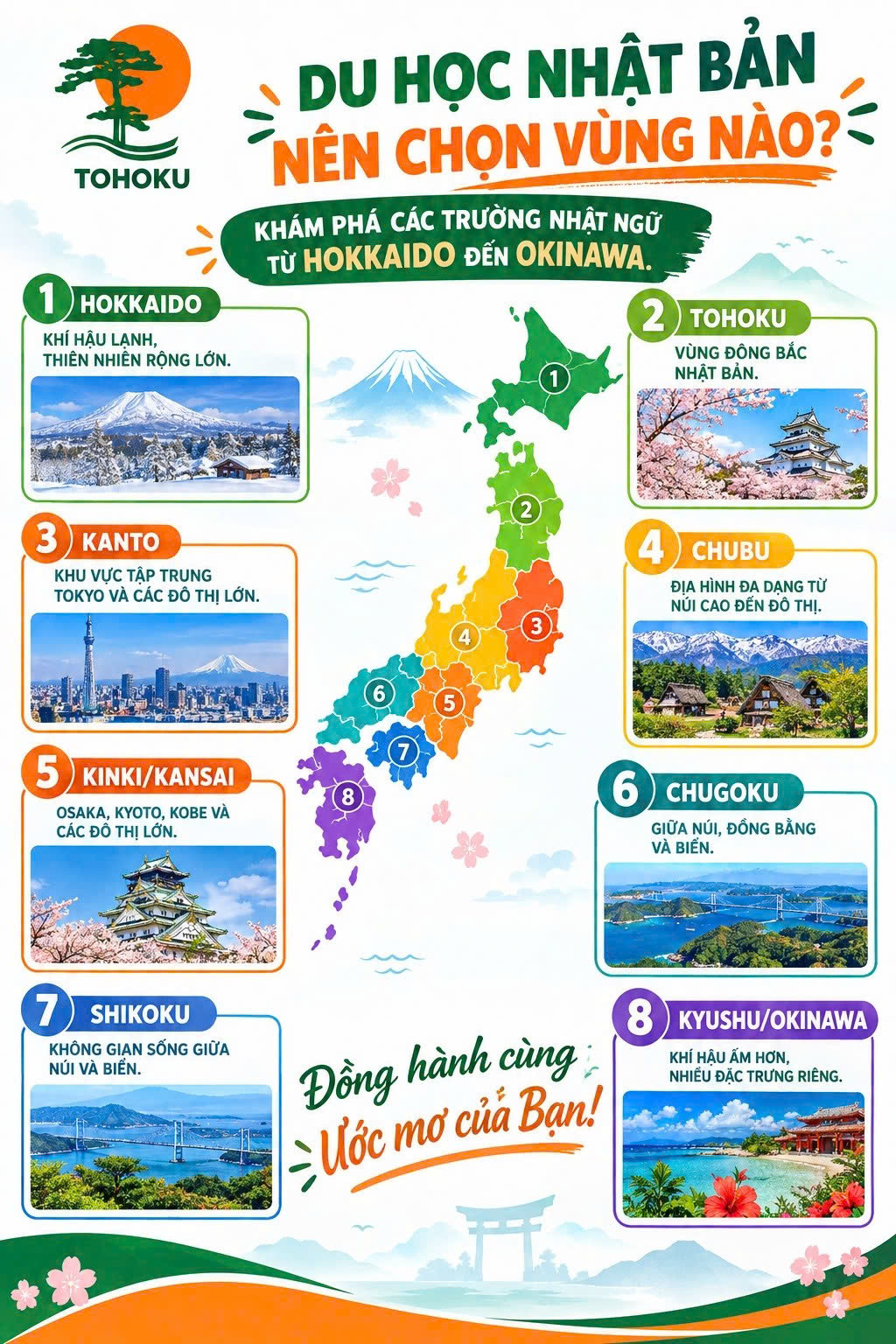
Study in Japan introduces Japan through eight major regions: Hokkaido, Tohoku, Kanto, Chubu, Kinki, Chugoku, Shikoku, and Kyushu/Okinawa.
Below is an overview of each region, together with Japanese language schools introduced by Tohoku Sông Đà.
-
HOKKAIDO – NORTHERN JAPAN
Hokkaido is located in the northernmost part of Japan and is known for its vast land, mountains, highlands, grasslands and natural scenery. It has a colder climate than most other parts of Japan, with significant snowfall in winter. Summers are generally cool and comfortable.
For students who enjoy nature, open spaces and a lifestyle different from Japan's major metropolitan areas, Hokkaido offers a distinctive environment.
Japanese language school:
J-ILA International Language Academy – Hakodate Campus
-
TOHOKU – NORTHEASTERN JAPAN
The Tohoku region consists of six prefectures: Aomori, Iwate, Miyagi, Akita, Yamagata and Fukushima.
Located in the north-eastern part of Honshu, Tohoku has a varied landscape of mountains, highlands, basins and coastal areas. Winters are cold, with heavy snowfall in some areas. The climate also differs between the Sea of Japan side and the Pacific side.
Compared with major metropolitan areas, many parts of Tohoku offer a quieter pace of life and a more spacious living environment.
-
KANTO – TOKYO AND THE SURROUNDING AREA
Kanto includes Tokyo, Kanagawa, Saitama, Chiba, Ibaraki, Tochigi and Gunma. It is centred around Tokyo and forms one of Japan's largest metropolitan areas.
The eastern part is largely covered by the Kanto Plain, while mountains are found in the north and west. Summers are generally hot and humid, while winters are cold. Tokyo and many coastal areas receive less snow than northern Japan.
Kanto has an extensive transport network and offers a wide range of schools, universities, companies and employment opportunities.
TOKYO
JIN Tokyo Japanese Language School
Sendagaya Japanese Institute
TOPA21 Japanese Language School
Akamonkai Japanese Language School
Sun-A International Academy Oedo School
Tokyo Gogaku Gakko (TGG)
Kyoritsu Japanese Language Academy
Shin Nihon Gakuin
Fuji International Language Institute
Tokyo Japanese Language Research Institute
IECC Japanese Language School
Tokyo World Japanese Language School
Eikou Japanese Language School – Tokyo Campus
SAITAMA
Musashi Urawa Japanese Language School
Nichigo Japanese Language School
Eikou Japanese Language School – Saitama Campus
IBARAKI
JOA Japanese Language School
Jyonan International Academy
CHIBA
Meiyuu Japanese Language Academy
-
CHUBU – CENTRAL HONSHU
Chubu includes Niigata, Toyama, Ishikawa, Fukui, Yamanashi, Nagano, Gifu, Shizuoka and Aichi.
The region has a highly diverse landscape, including mountains, highlands, plains and coastal areas.
Niigata and other areas along the Sea of Japan receive significant snowfall in winter. Nagano is known for its mountainous terrain and high elevations. Shizuoka is located along the Pacific coast and is home to Mount Fuji, while Aichi has a major urban and industrial centre around Nagoya.
SHIZUOKA
SYONAN Japanese Language School – Hamamatsu
NAGANO
Nagano International Culture College
AICHI
Kyoshin Language Academy (KLA)
NAGANO
ISI Japanese Language School – Nagano Campus
-
KINKI – KANSAI: OSAKA, KYOTO AND KOBE
The Kinki region consists of Mie, Shiga, Kyoto, Osaka, Hyogo, Nara and Wakayama. It is also commonly referred to as the Kansai region.
The area combines major cities with regions rich in history and traditional culture. Osaka is located on a broad coastal plain, Kyoto lies in a basin surrounded by mountains, while Kobe has mountains and the sea in close proximity.
Summers are generally hot and humid, while winters are relatively moderate compared with northern Japan. Tohoku Sông Đà introduces a number of Japanese language schools in Osaka, Kyoto and Hyogo.
OSAKA
Minato Japanese Language School
MERIC Japanese Language School
Osaka International Academy
Osaka International Academy South Campus
JVC Academy Osaka
Himawari Japanese Language School
First Study Japanese Language School
Osaka Gaigo Academy
J-ILA – Osaka Campus
KYOTO
J-ILA – Kyoto Campus
Kyoshin Language Academy (KLA)
ISI Japanese Language School – Kyoto Campus
HYOGO
Kyoshin Language Academy (KLA) – Kobe Campus
-
CHUGOKU – WESTERN HONSHU
The Chugoku region consists of Hiroshima, Okayama, Yamaguchi, Tottori and Shimane.
The Chugoku Mountains run through the central part of the region, creating differences between mountainous and coastal areas.
The Seto Inland Sea side generally has a milder climate, while the Sea of Japan side is colder in winter and some areas receive considerable snowfall.
Okayama and Hiroshima are important urban and transport centres in the region.
OKAYAMA
Osafune Japanese Language School
-
SHIKOKU – FOUR PREFECTURES SOUTH OF HONSHU
Shikoku consists of Tokushima, Kagawa, Ehime and Kochi.
The island is largely mountainous, while plains are concentrated around urban and coastal areas.
Compared with northern Japan, many parts of Shikoku have a warmer climate. However, rainfall and weather conditions vary from one prefecture to another.
Shikoku offers a different living environment from major metropolitan areas such as Tokyo and Osaka, with a combination of mountains, coastline and medium-sized cities.
-
KYUSHU/OKINAWA – SOUTHWESTERN JAPAN
Study in Japan introduces Kyushu and Okinawa as one region, covering Fukuoka, Saga, Nagasaki, Kumamoto, Oita, Miyazaki, Kagoshima and Okinawa.
Kyushu has diverse landscapes, including mountains, volcanoes, plains and coastal areas. The climate is generally warmer than in Hokkaido, Tohoku and Kanto, with hot and humid summers. Some areas receive heavy rainfall and may be affected by typhoons.
Fukuoka is one of the major economic, educational and transport centres in southwestern Japan.
FUKUOKA
Hiro Gakuin
Nishinihon International Education Institute
J-ILA – Fukuoka Campus
OKINAWA
Okinawa is an island region in southwestern Japan with a subtropical climate. Winters are much warmer than in northern Japan. The sea, islands and Ryukyu culture are distinctive features of the region.
WHICH REGION SHOULD YOU CHOOSE FOR STUDYING IN JAPAN?
When choosing a Japanese language school, it is useful to compare regions based on the factors that matter most to you.
• Hokkaido: Cold climate, snowfall, vast natural surroundings and relatively cool summers.
• Tohoku: Mountainous terrain, cold winters and heavy snowfall in some areas.
• Kanto: Tokyo and its surrounding metropolitan area, developed transport networks and a wide range of schools and part-time employment opportunities.
• Chubu: Diverse terrain, from mountain areas to major cities such as Nagoya and Shizuoka, as well as highland areas such as Nagano.
• Kinki/Kansai: Osaka, Kyoto and Kobe, combining major urban centres with rich historical and cultural environments.
• Chugoku: A combination of mountains, plains and coastal areas, with medium-sized cities and varied living environments.
• Shikoku: Mountains and coastline, with a lifestyle that differs from Japan's largest metropolitan areas.
• Kyushu/Okinawa: Generally warmer climate. Fukuoka is a major city in the region, while Okinawa offers a distinctive island environment and subtropical climate.
When choosing a Japanese language school, students and parents should consider the school's location, climate, living costs, transport access, admission requirements and post-graduation plans.
Housing costs can also vary considerably between regions. Therefore, in addition to tuition fees, students should estimate monthly living expenses, including accommodation and transport.
CONTACT INFORMATION
Songda Tohoku Joint Stock Company
Address: L02-L01, Khu A, KĐT Dương Nội, Phường Dương Nội, Hà Nội
Hotline: 0989 044 852
Email: tohokusongda2014@gmail.com
Website: tohoku.vn