


After arriving in Japan, international students need to take care of several important tasks within a short period of time, including settling into their accommodation, registering their address, arranging health insurance, opening a bank account, getting a mobile phone or SIM card, learning how to use public transport and preparing for school.
For students who have never lived in Japan before, these procedures and daily-life rules can sometimes be confusing. Organising the tasks by day can make the first week much easier and help ensure that important procedures are not overlooked.
Below is a practical checklist of the key things international students should prioritise during their first seven days in Japan.
DAY 1: MOVE INTO YOUR ACCOMMODATION AND CHECK EVERYTHING
After arriving in Japan, your first priority is usually to travel to your accommodation, such as a school dormitory or private residence.
Once you arrive, check the following:
-
The condition of the room, entrance door and locks.
-
Whether electricity, water and gas are working properly.
-
Air conditioning, washing machine, refrigerator, kitchen and other equipment.
-
Internet or Wi-Fi access, if provided.
-
Which items are already provided and which ones you need to purchase yourself.
It is advisable to take photographs of the room when you first move in, particularly if there are any existing scratches, damage or defects. Keeping a record of the room's condition can help prevent disputes when you eventually move out.
You should also save your full address in Japanese on your mobile phone. You may need to provide the exact address when completing administrative procedures, ordering goods or taking a taxi.
DAY 2: REGISTER YOUR ADDRESS AND COMPLETE RESIDENCE-RELATED PROCEDURES
Once you have settled into your accommodation, you should complete the necessary address registration procedures at the municipal office responsible for the area where you live.
Foreign residents staying in Japan for the relevant period are generally required to notify the authorities of their address within the legally specified period. If your school or a member of staff is helping you, confirm in advance where you need to go, the opening hours and which documents you need to bring.
Documents commonly required may include:
-
Residence Card (在留カード).
-
Passport.
-
Documents relating to your accommodation, where required.
-
Any other documents requested by the local authority.
You may also receive information about National Health Insurance and other administrative procedures during this visit.
Do not assume that you can ignore address registration simply because you already have a Residence Card. Your registered address is important for living, studying and completing various procedures in Japan.
DAY 3: CHECK AND ARRANGE YOUR HEALTH INSURANCE
Healthcare costs in Japan can be significant without appropriate insurance coverage. International students should therefore check their insurance status soon after arriving.
Students who are required to join the National Health Insurance system (国民健康保険) generally complete the necessary procedures through the municipal office in their area of residence.
After registering, make sure you understand:
-
The personal information shown on your insurance-related documents.
-
The amount of your insurance premiums and how to pay them.
-
Any notices or documents sent to your registered address.
-
Where to contact if you have questions.
Health insurance premiums are part of your regular living expenses. When preparing your monthly budget, remember to account for them alongside rent, food and transport costs.
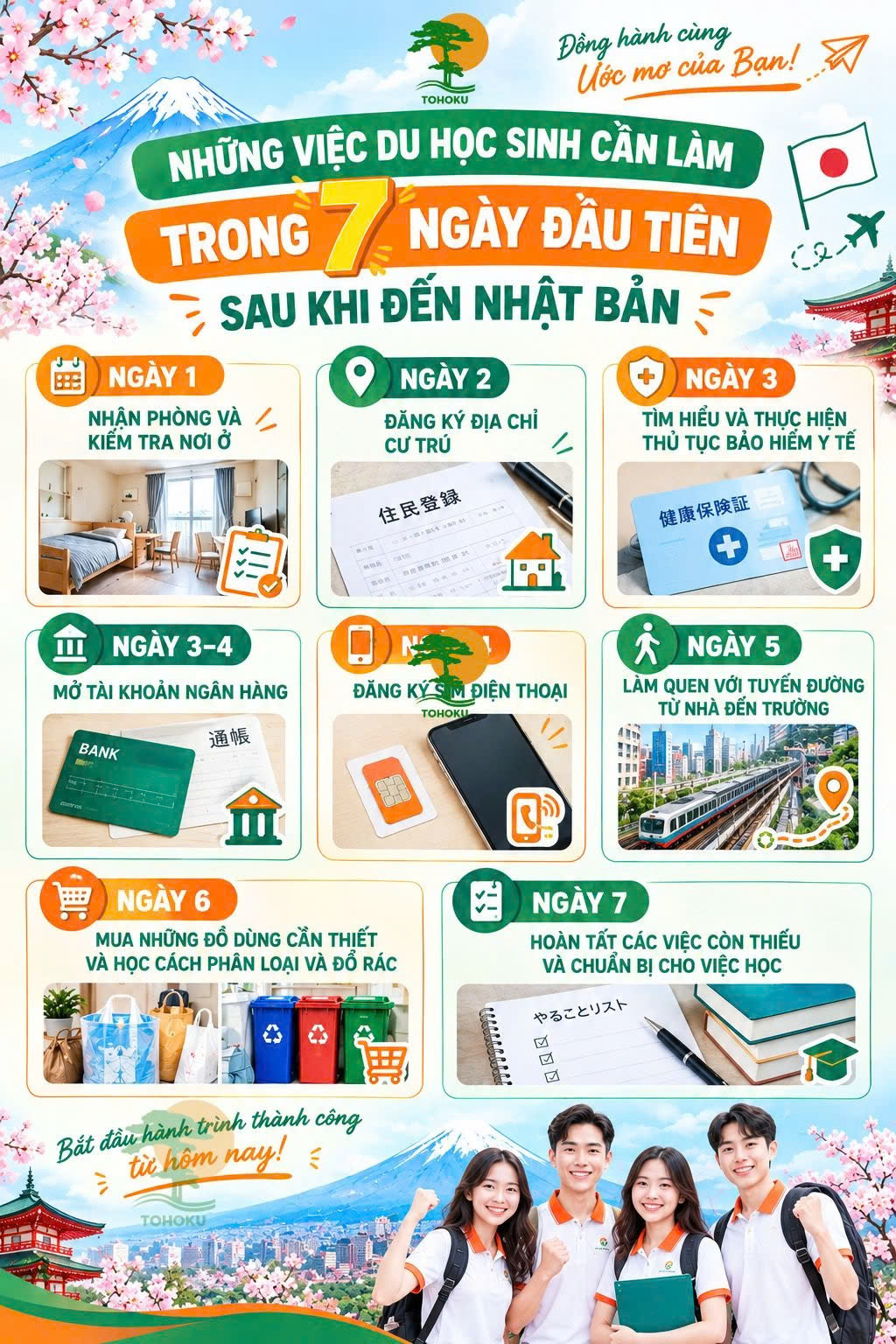
DAY 3–4: OPEN A BANK ACCOUNT
A Japanese bank account may be necessary for everyday life. It can be used to manage living expenses and, in some cases, receive wages from part-time employment.
When opening an account, banks may ask for identification documents such as your Residence Card and passport, as well as other documents depending on your circumstances.
Before visiting a bank, check:
-
Whether newly arrived international students can open an account.
-
Whether a Japanese mobile phone number is required.
-
Whether proof of address is required.
-
Whether there are any requirements relating to your period of residence.
There is usually no need to open several bank accounts immediately after arriving in Japan. Start with one account that suits your needs for managing living expenses, making payments and receiving wages if necessary.
DAY 4: GET A MOBILE PHONE AND SIM CARD
Having a Japanese mobile phone number can be useful for communicating with your school, registering for services, dealing with banks and contacting a part-time employer.
Depending on your mobile phone, you may be able to choose between a physical SIM card and an eSIM.
When choosing a mobile phone plan, check:
-
Initial registration or set-up fees.
-
Monthly charges.
-
Data allowance.
-
Call charges.
-
Cancellation and plan-change conditions.
-
Whether the service provides reliable coverage in the area where you live.
Do not choose a plan simply because it has the lowest price. Consider your actual usage and whether the monthly cost is affordable for your budget.
DAY 5: LEARN YOUR ROUTE FROM HOME TO SCHOOL
During your first week, take the time to travel from your accommodation to school at least once before your first full day of classes.
You should identify:
-
The nearest railway station or bus stop to your accommodation.
-
The nearest station or bus stop to your school.
-
The train or bus routes you need to use.
-
The actual journey time.
-
Any necessary train changes.
-
First and last train times if you regularly travel early in the morning or return late.
Map and transport apps such as Google Maps can be very useful for checking routes.
However, do not rely solely on the estimated journey time shown by an app. Make the journey yourself at least once so that you can identify the correct station exits, platforms and walking routes.
Knowing your route in advance can help you avoid taking the wrong train or arriving late at school during your first few days.
DAY 6: BUY ESSENTIAL ITEMS FOR DAILY LIFE
Once your accommodation is organised, make a list of the things you genuinely need and prioritise your purchases.
There is no need to buy everything at once. Start with essential items such as:
-
Toiletries and everyday household items.
-
Bedding, sheets and pillows, if they are not already provided.
-
Kitchen equipment.
-
Stationery and study materials.
-
Clothing suitable for the season.
-
Any personal medicines or hygiene products you need.
You should also locate useful facilities around your accommodation, such as supermarkets, convenience stores, pharmacies, hospitals, post offices and banks.
Save frequently used places in your map application so that you can find them quickly when necessary.
DAY 6: LEARN HOW TO SORT AND DISPOSE OF RUBBISH
Waste separation and disposal are important aspects of everyday life in Japan.
The rules, collection days and disposal locations can vary between local authorities.
Depending on the area, rubbish may be separated into categories such as burnable waste, non-burnable waste, bottles and cans, plastic bottles, plastics and bulky waste.
Ask your accommodation manager, school or local authority about:
-
How rubbish should be separated.
-
Which days different types of rubbish are collected.
-
Where rubbish should be placed.
-
Whether designated rubbish bags are required.
Do not simply follow the rules from another area. Always follow the waste disposal rules of the municipality where you currently live.
DAY 7: CHECK YOUR DOCUMENTS AND PREPARE FOR SCHOOL
On the seventh day, take some time to review the procedures you have completed and organise your important documents.
Use the following checklist:
□ I have moved into my accommodation and checked its condition.
□ I have completed the necessary address registration procedures.
□ I have checked my health insurance arrangements.
□ I have prepared a bank account if necessary.
□ I have a reliable mobile phone or other means of communication.
□ I know how to travel from my accommodation to school.
□ I know where to buy food and everyday necessities.
□ I understand the local rubbish separation and collection rules.
□ I have saved the contact details of my school and relevant staff.
□ I have checked my passport, Residence Card and other important documents.
It is useful to keep photographs or copies of important documents on your mobile phone or in another secure location where appropriate. However, original documents such as your passport and Residence Card should always be kept somewhere safe.
SHOULD YOU START A PART-TIME JOB DURING YOUR FIRST WEEK?
Many international students want to find part-time work soon after arriving in Japan in order to help cover their living expenses.
However, there is no need to rush. During your first few days, prioritise settling into your accommodation, completing the necessary administrative procedures and becoming familiar with your school routine.
Before starting a part-time job, check your status of residence, whether you have permission to engage in activities outside your permitted status of residence, and any applicable restrictions, including working-hour limits.
When looking for a job, check the workplace location, working hours, wages, duties and shifts in advance. Most importantly, make sure that your part-time work does not interfere with your studies.
PRIORITISE SETTLING INTO DAILY LIFE DURING YOUR FIRST 7 DAYS IN JAPAN
You do not need to complete everything within the first day or two after arriving in Japan.
The key is to understand which tasks should be completed first, which can wait, and when you need to ask your school or the relevant person for help.
A simple way to organise your first week is:
Day 1: Settle into your accommodation.
Day 2: Complete the necessary address and residence-related procedures.
Day 3: Check your health insurance and prepare your bank account.
Day 4: Set up your mobile phone and communication arrangements.
Day 5: Learn your route to school and become familiar with local transport.
Day 6: Buy essential items and learn about rubbish disposal and useful facilities nearby.
Day 7: Check your important documents, complete any outstanding procedures and prepare for school.
A well-organised first week can make the transition to life in Japan much easier. Using a checklist, keeping important documents organised and saving key contact details will help you feel more prepared.
If you are unsure about a procedure or encounter a problem, contact your school or the relevant person as soon as possible and ask for assistance.
CONTACT INFORMATION
Songda Tohoku Joint Stock Company
Address: L02-L01, Khu A, KĐT Dương Nội, Phường Dương Nội, Hà Nội
Hotline: 0989 044 852 / 0989044852
Email: tohokusongda2014@gmail.com
Website: https://tohoku.vn