


For many international students in Japan, South Korea and other countries, part-time work is an important way to help cover living expenses. However, accepting a job without checking the recruitment information carefully can result in financial losses, unpaid wages or even involvement in illegal activities.
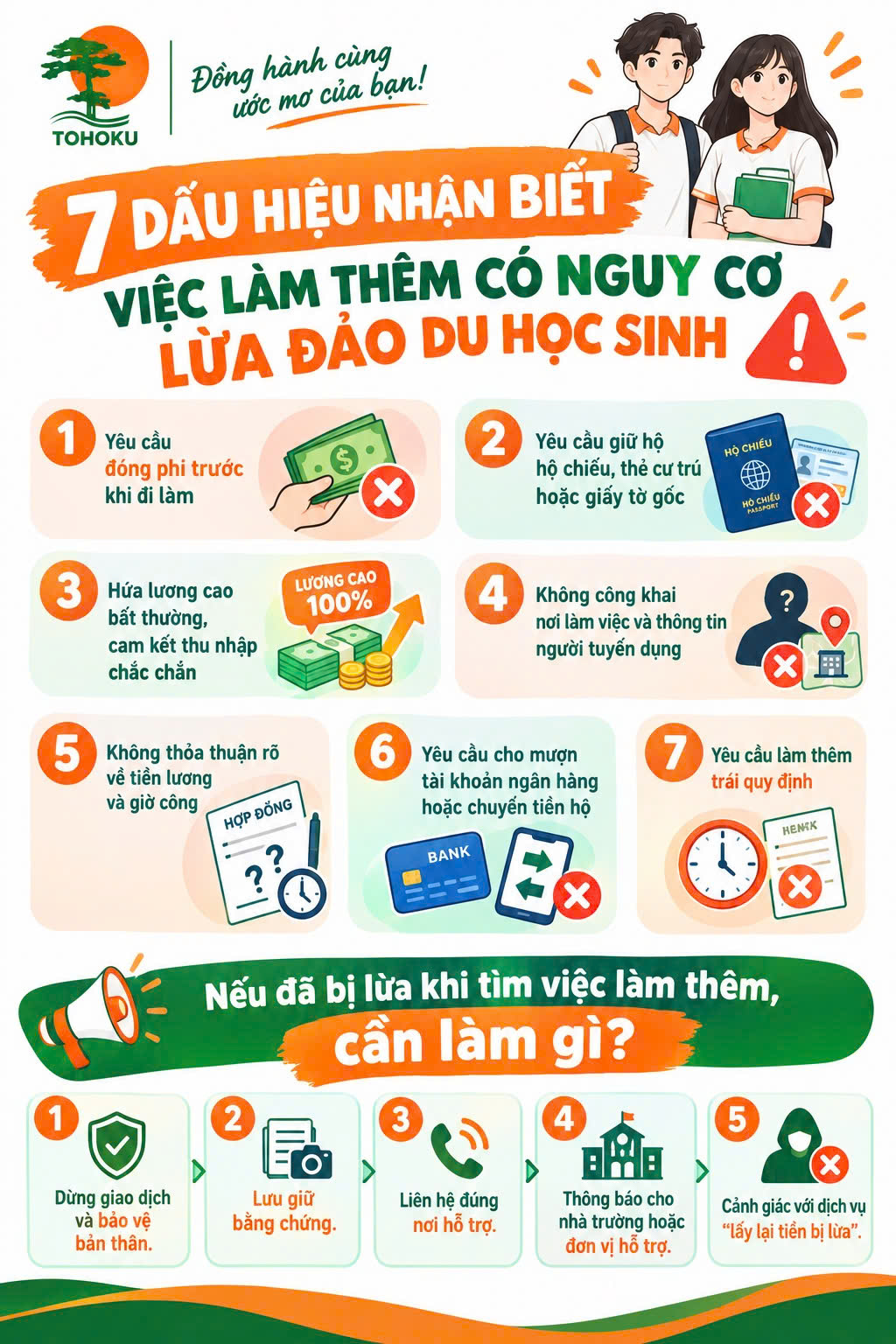
Before accepting a job, look out for these seven warning signs.
1. Being asked to pay fees before starting work
Recruiters may ask applicants to pay job placement fees, reservation fees or deposits without clearly explaining the reasons or providing valid receipts.
What to do: Do not transfer money until you have verified the employer and the legitimacy of the charge. If you have already paid, keep the transfer receipt, messages and recipient account details. Contact your bank promptly to ask whether the transaction can be investigated or any measures can be taken to prevent further losses.
2. Being asked to hand over your passport, residence card or original documents
Be cautious if an employer wants to keep your passport, residence card or other original documents for an extended period without a clear reason, or refuses to return them when requested.
What to do: Request the return of your documents and inform your school or student support organisation. If your documents are withheld or you face threats or coercion, seek assistance from the relevant authorities in your host country.
3. Promises of unusually high wages or guaranteed earnings
Advertisements promising “easy work with high pay”, “no language skills required” or “enough income to cover all tuition and living expenses” should be treated with caution, particularly when working hours, wages and payment conditions are not clearly stated.
What to do: Ask for specific details about the hourly wage, working hours, deductions and payday. If the information appears misleading, do not proceed with the arrangement. Keep the advertisement and messages as evidence, and report the matter to the recruitment platform or relevant authorities.
4. No clear information about the employer or workplace
A recruiter may refuse to disclose the company name, workplace address or contact details, or repeatedly change the interview location or place of work.
What to do: Verify the employer's details and workplace address before attending an interview. If you notice anything suspicious, leave the location if it is safe to do so and contact someone you trust. Do not follow strangers to another location without a clear and legitimate reason.
5. Unclear wage agreements or working-hour records
Employers may fail to explain how wages are calculated, repeatedly delay payment or refuse to record the hours actually worked. These practices can lead to underpayment or unpaid wages.
What to do: Keep work schedules, timesheets, payslips, messages and bank transfer records. If wages are withheld, request payment in writing. If the issue remains unresolved, contact a labour consultation service or the relevant authorities in your host country.
6. Being asked to lend your bank account or transfer money for someone else
This is an especially serious warning sign. A recruiter may ask to use your bank account to receive, transfer or withdraw money on their behalf. Your account could be used to move funds connected to fraud or other criminal activities.
What to do: Never lend or sell your bank account or give anyone your bank card, password, PIN or one-time password (OTP). If you have already shared your banking details or made a suspicious transfer, contact your bank immediately and report the matter to the relevant authorities where appropriate. Preserve all evidence and do not transfer additional money at the recruiter's request.
7. Being asked to work in breach of immigration or employment regulations
Some employers may ask international students to work beyond permitted hours, use another person's documents or undertake work that is not permitted under their immigration status.
In Japan, students holding the residence status of “Student” generally need permission to engage in activities outside their status of residence before starting part-time work. The general limit is 28 hours per week during term time and up to eight hours per day during long school holidays designated by the educational institution. Certain types of work are prohibited even when permission has been granted.
In South Korea, the conditions for part-time employment depend on the student's immigration status and the applicable permission or notification requirements, as well as the relevant working-hour limits.
What to do: Before accepting a job, confirm your eligibility and working conditions with your school or the relevant immigration authority. Do not rely solely on a recruiter's assurance that permission is unnecessary or that violations will go unnoticed.
What to Do If You Have Already Been Scammed
Step 1: Stop suspicious transactions and protect yourself.
Do not send any more money or disclose additional personal information. If you are being threatened, avoid meeting the person alone. Move to a safe location and contact local emergency services if you are in immediate danger.
Step 2: Preserve the evidence.
Save job advertisements, messages, phone numbers, recipient account details, payment receipts, employment agreements and working-hour records. Do not delete or alter the original evidence.
Step 3: Contact the appropriate organisation based on the type of incident.
-
Payment fraud or compromised banking details: Contact your bank immediately and report the incident to the police or other relevant authorities.
-
Unpaid wages: Contact a labour consultation service or the relevant labour authorities.
-
Withheld documents, threats or coercion: Seek help from your school, local authorities or, where necessary, a Vietnamese diplomatic mission in your host country.
-
Concerns about immigration or employment violations: Consult your school or the relevant immigration authority to determine the appropriate course of action.
Step 4: Inform your school or support organisation.
Provide the available evidence and ask for guidance. If you are concerned about the impact on your immigration status, seek advice promptly rather than concealing the incident or continuing suspicious work.
Step 5: Beware of secondary scams promising to recover your money.
Be cautious of individuals or services claiming they can guarantee a refund, recover funds by accessing your bank account or retrieve your money in exchange for an additional fee. These offers may be another attempt to defraud you.
Reporting a scam does not guarantee that your money will be recovered. However, acting quickly can help preserve evidence and enable the relevant authorities to investigate the incident.
Advice for International Students
Before accepting a part-time job, verify the recruitment information, employment conditions and applicable regulations. If you become a victim of fraud, protect yourself, preserve the evidence and seek help from the appropriate authorities. Do not make additional payments or continue unlawful work in a way that could worsen the situation.
CONTACT INFORMATION
Songda Tohoku Joint Stock Company
Address: L02-L01, Zone A, Duong Noi Urban Area, Duong Noi Ward, Hanoi, Vietnam
Hotline: 0989 044 852
Email: tohokusongda2014@gmail.com
Website: https://tohoku.vn