


Before going to Japan to study, international students need to prepare not only their documents, finances and Japanese language skills, but also learn how to deal with emergencies that may arise in everyday life.
When something goes wrong in a foreign country, knowing whom to call, where to seek help and what to do first can help you protect yourself and get assistance in time.
1. Being involved in an accident or facing a life-threatening emergency
In Japan, call 119 for an ambulance or the fire service. If you are involved in a road traffic accident or need police assistance, call 110.
When calling, explain the location, the condition of the person involved and any other relevant information as clearly as possible. If you cannot communicate effectively in Japanese, ask someone nearby to help.
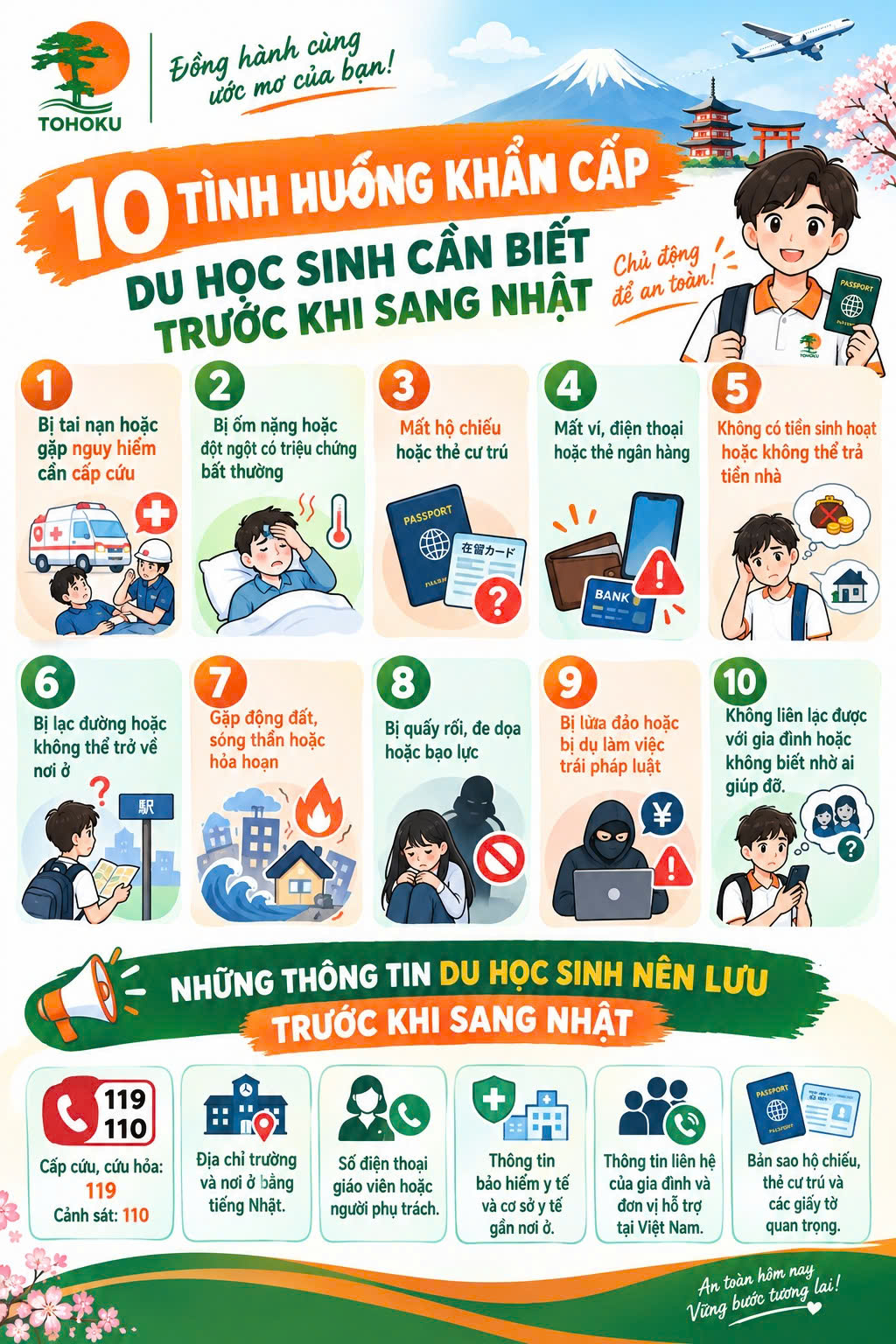
2. Becoming seriously ill or experiencing sudden, unusual symptoms
If you have difficulty breathing, severe chest pain, lose consciousness or experience other potentially life-threatening symptoms, call 119 for an ambulance. Do not attempt to travel alone or try to endure the symptoms if your condition is serious.
For less severe symptoms, contact an appropriate medical facility. Inform your school or the person responsible for supporting you if you need to miss classes.
3. Losing your passport or residence card
If you lose your passport, contact the Vietnamese diplomatic mission in Japan for guidance on the necessary procedures.
If you lose your residence card (在留カード), report the loss to the police and follow the official procedures for obtaining a replacement. In general, an application for reissuance must be submitted within 14 days of discovering the loss, subject to applicable exceptions.
Keep copies of important documents in a safe place, separate from the originals.
4. Losing your wallet, phone or bank card
If you lose your wallet or personal belongings, retrace your steps and contact nearby facilities that may have a lost-property service.
If you lose your bank card, contact your bank immediately to block it. If your phone is lost, suspend your SIM card and secure important accounts to prevent unauthorised access.
If you suspect theft, report it to the police.
5. Running out of living expenses or being unable to pay rent
If you experience financial difficulties, speak to your family, school or support organisation as early as possible. Do not wait until you have no money for food or have fallen behind on rent before seeking help.
Avoid borrowing money from strangers, using unregulated lending services or accepting illegal work just to obtain money quickly.
If the financial difficulties continue, review your expenses, income and available support options with the person responsible for assisting you.
6. Getting lost or being unable to find your way home
Go to a safe public place, such as a staffed railway station, a convenience store or the nearest police box (交番), and ask for assistance.
Save your home address in Japanese on your phone or write it down on paper. If your phone runs out of battery, having the address written down will help you explain where you need to go.
Before travelling to an unfamiliar place, check your route home and make sure your phone has enough battery.
7. Experiencing an earthquake, tsunami or fire
During an earthquake, stay away from windows and objects that could fall, protect your head and follow the evacuation instructions for your location.
If a tsunami warning is issued, move quickly to higher ground or an designated evacuation site as instructed by the authorities. Do not return to a dangerous area to collect your belongings.
If a fire breaks out, leave the building using the emergency exits, do not use the lift and call 119 once you are in a safe location.
8. Experiencing harassment, threats or violence
If you are in immediate danger, leave the area if possible and call the police on 110.
Seek assistance from a teacher, dormitory manager, support coordinator or another trusted person. If you are injured, obtain medical attention.
Do not suffer in silence because you are worried about how the incident might affect your studies or work. If the incident occurs at your school, accommodation or part-time workplace, keep any relevant information and evidence safely.
9. Being scammed or persuaded to take part in illegal work
Be cautious of job offers promising unusually high earnings, requests for advance payments, or requests to lend your bank account or receive and transfer money or goods of unknown origin.
If you have already transferred money or shared personal information, contact your bank for assistance, preserve messages and transaction records, and report the matter to the relevant authorities when necessary.
Never lend your bank card, account, residence card or personal documents to someone for transactions whose purpose you do not understand. Such activities can expose you to serious legal risks.
10. Being unable to contact your family or not knowing whom to ask for help
Before departure, agree on a communication routine with your family. Save the contact details of your school, your support coordinator in Japan, your support organisation in Vietnam and the relevant emergency services.
If you encounter a problem that you cannot resolve yourself, contact the person responsible for supporting you. Explain clearly where you are, what has happened and what assistance you need.
If your family in Vietnam cannot reach you for an unusually long period, contact your school or support organisation so that they can help check on your situation.
IMPORTANT INFORMATION TO SAVE BEFORE GOING TO JAPAN
-
Ambulance and fire service: 119
-
Police: 110
-
Your school and accommodation addresses written in Japanese.
-
Phone numbers for your teacher or support coordinator.
-
Health insurance information and details of medical facilities near your accommodation.
-
Contact details for your family and support organisation in Vietnam.
-
Copies of your passport, residence card and other important documents.
International students cannot predict every emergency, but they can prepare themselves to respond without being caught off guard. Save essential information, familiarise yourself with the appropriate procedures and remember that when a serious problem occurs, seeking help promptly is more important than trying to handle everything alone.
CONTACT INFORMATION
Songda Tohoku Joint Stock Company
Address: L02-L01, Area A, Duong Noi Urban Area, Duong Noi Ward, Hanoi, Vietnam
Hotline: 0989 044 852
Email: tohokusongda2014@gmail.com
Website: https://tohoku.vn