


Recent reports of the earthquake in Japan have caused understandable concern among many families in Vietnam. After seeing news reports or videos on social media, many parents immediately try to call their children who are studying or working in Japan. However, in many cases, phone calls cannot get through or there is no immediate response.
In reality, temporary communication disruptions after a natural disaster are quite common. Mobile networks may become overloaded, power outages may occur, phones may run out of battery, or students and workers may be evacuating to designated shelters under the instructions of local authorities.
In such situations, the most important thing is to remain calm and follow the steps below.
1. Stay Calm and Avoid Repeated Phone Calls
Immediately after an earthquake, thousands of people attempt to contact their families at the same time, which can overload communication networks.
You should:
-
Wait 15–30 minutes before calling again.
-
If the call does not connect, send a text message instead.
-
Be patient and wait for a reply rather than making repeated calls.
Avoid:
-
Calling dozens of times in succession.
-
Panicking simply because you cannot reach your child for a short period.
2. Prioritise Text Messages
When communication networks are unstable, SMS messages or messaging applications such as LINE, Messenger, or Zalo are often more reliable than voice calls.
A simple message such as:
"We're all safe at home. Please message us when you are safe."
can reassure your child without adding unnecessary pressure during an emergency.
3. Check the Area Where Your Child Lives
Not every part of Japan is affected to the same extent after an earthquake.
Before becoming overly concerned, determine:
-
Which prefecture or city your child lives in.
-
Whether that area has been affected.
-
Whether there are tsunami warnings or evacuation orders.
Understanding your child's location will help you assess the situation more accurately.
4. Follow Official Information Sources
Keep updated through reliable sources, including:
-
Japan Meteorological Agency (JMA)
-
NHK World-Japan
-
Embassy of Vietnam in Japan
-
Vietnam Labour Management Board in Japan
-
Your sending organisation
-
Your child's school, supervising organisation, or employer
Do not:
-
Rely solely on unverified social media posts or videos.
-
Share information that has not been confirmed.
5. Contact the Sending Organisation
If you still cannot reach your child after a reasonable period, contact the organisation that arranged their study or employment in Japan.
For students, technical interns, and engineers supported by Song Da TOHOKU Joint Stock Company, we maintain close communication with:
-
Supervising organisations
-
Host companies
-
Japanese language schools and universities
-
Our partners throughout Japan
As soon as verified information becomes available, we will promptly notify families.
6. Contact Vietnamese Emergency Support Services When Necessary
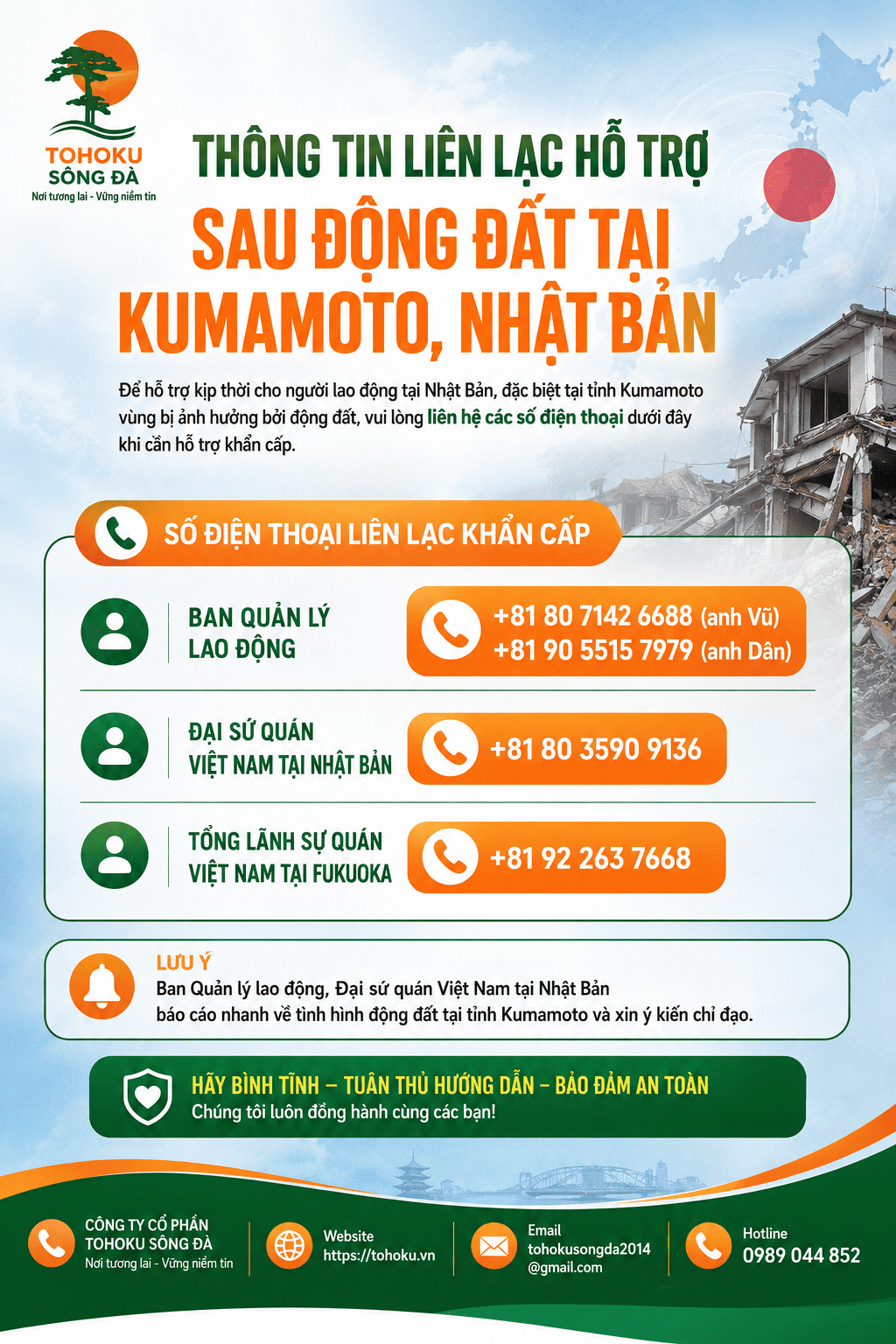
The Vietnamese representative offices in Japan have announced the following emergency contact numbers:
Vietnam Labour Management Board in Japan
-
Mr. Vu: +81 80 7142 6688
-
Mr. Dan: +81 90 5515 7979
Embassy of Vietnam in Japan
-
+81 80 3590 9136
Consulate General of Vietnam in Fukuoka
-
+81 92 263 7668
If necessary, workers, students, or their family members may contact these offices for guidance and assistance.
7. Keep Your Child's Important Information Ready
Every family should keep the following information readily available:
-
Residential address in Japan
-
School or host company
-
Supervising organisation (for technical interns)
-
Name and phone number of the person in charge
-
Sending organisation's contact number
-
Passport number
-
Residence card number
-
Prefecture or city of residence
Having this information prepared in advance will significantly speed up assistance if an emergency occurs.
8. Do Not Spread Unverified Information
Following major earthquakes, social media is often flooded with old photos or videos that are reposted as though they are current.
Sharing unverified information can create unnecessary panic among families and the wider community.
Please only share information released by government authorities or reputable news organisations.
UPDATE FROM SONG DA TOHOKU
After proactively contacting supervising organisations, educational institutions, host companies, business partners in Japan, and directly verifying the situation with our students and workers, Song Da TOHOKU Joint Stock Company has confirmed that 100% of our technical interns, engineers, and international students currently in Japan are safe.
This is welcome news for their families and for all employees of our company.
We sincerely thank our supervising organisations, schools, host companies, and partners across Japan for their close cooperation and timely information, enabling us to quickly verify the safety of our students and workers.
Nevertheless, Japanese authorities continue to warn of possible aftershocks. Therefore, Song Da TOHOKU encourages all technical interns, engineers, and international students to continue monitoring official announcements, prepare essential emergency supplies, and strictly follow local disaster preparedness guidelines.
Song Da TOHOKU will continue to stand alongside our students and workers, maintain close communication with our partners in Japan, and remain ready to provide support whenever needed.
KEY REMINDERS
If you cannot contact your child in Japan after an earthquake, remember these eight essential points:
✓ Stay calm and do not panic.
✓ Avoid making repeated phone calls.
✓ Send text messages whenever possible.
✓ Check the area where your child is living.
✓ Follow information from official sources.
✓ Contact your sending organisation if necessary.
✓ Keep emergency contact numbers readily available.
✓ Do not share unverified information.
Remaining calm, relying on accurate information, and maintaining timely coordination between families, the sending organisation, and partners in Japan will help ensure that technical interns, engineers, and international students receive prompt and effective support when they need it most.